


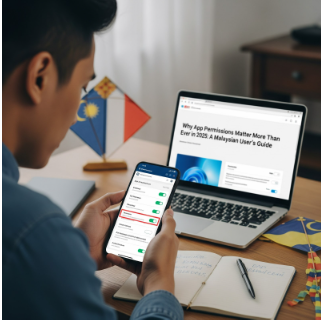
Most of us install apps without thinking twice.
Tap “Allow,” “Allow,” “Allow”… then close the pop-up and start using the app.
But in 2025, app permissions have become one of the most important — and most overlooked — parts of mobile safety in Malaysia. As apps become more connected, more data-driven, and more integrated with other services, users need to understand what they’re giving away each time they press “Allow.”
This guide explains why permissions matter, what risks Malaysians are exposed to, and how to audit your apps the right way.
- Apps Today Request More Access Than Ever
A decade ago, most apps used:
camera
storage
location
notifications
Now, modern apps may request permissions such as:
device ID access
precise location
network control
background activity
file read/write
“install unknown apps” (for APK users)
Most Malaysians don’t realize how powerful these permissions are.
For example, granting network control allows an app to manage your connectivity in the background. Granting file access lets it read photos and documents. When combined, these can create serious privacy risks if the app is not trustworthy.
- Why Malaysians Are Now More Cautious
In recent years, Malaysia has seen:
increased phishing attacks
cloned apps disguised as originals
modified APKs circulating on social platforms
apps secretly collecting location data
cases of hidden adware or auto-installers
Because of this, many users now scrutinize permissions before downloading anything.
Platforms that provide clear explanations, file information, and installation guidance help users understand what’s normal and what isn’t.
For example, some sites — like Mega888Today — show users what a properly structured download or guide page looks like, simply as a reference point for transparency: https://mega888today.com/
- The Hidden Risks of Over-Permissive Apps
Granting too many permissions can cause:
✔ Data harvesting
Some apps track behaviour, location, and device usage patterns.
✔ Background battery drain
Unnecessary background permissions can drain your phone faster.
✔ Auto-update from unknown sources
A dangerous permission that lets malicious apps install other files silently.
✔ Exposure to cloned app attacks
Especially when APKs are downloaded from unverified sources.
✔ Cross-app tracking
Some permissions let apps monitor other app activity.
These risks multiply when users install apps from random links shared in group chats or forwarded messages.
- How Malaysians Can Audit Their App Permissions in Under 5 Minutes
A simple monthly check can improve device safety dramatically.
Step 1 — Go to App Info
Check which apps have the most permissions.
Step 2 — Disable permissions you don’t need
If a calculator wants your location — red flag.
If a game wants to modify system settings — bigger red flag.
Step 3 — Review Installed APKs
Especially apps not from the Play Store.
Step 4 — Look for excessive background activity
Some apps keep the device awake unnecessarily.
Step 5 — Compare with a legitimate info page
Seeing how real apps present their installation steps and file notes helps identify suspicious apps.
- Why Permission Awareness Will Matter Even More in the Future
As mobile apps evolve into mini-ecosystems — linked to wallets, cloud storage, identity systems, and social networks — the amount of power they have will grow.
In 2025 and beyond, digital hygiene isn’t just about avoiding malware.
It’s about:
understanding what an app wants
knowing why it wants it
checking if the request matches the app’s function
An app that needs fewer permissions is usually a safer app.
Conclusion
App permissions used to be something we ignored.
Today, they are one of the clearest indicators of whether an app respects your privacy or exposes you to risk.
By reviewing permissions regularly, avoiding random download links, and understanding how a trustworthy information page is structured, Malaysians can protect themselves while still enjoying the apps they love.
Good digital hygiene takes minutes — but keeps your device safe for years.